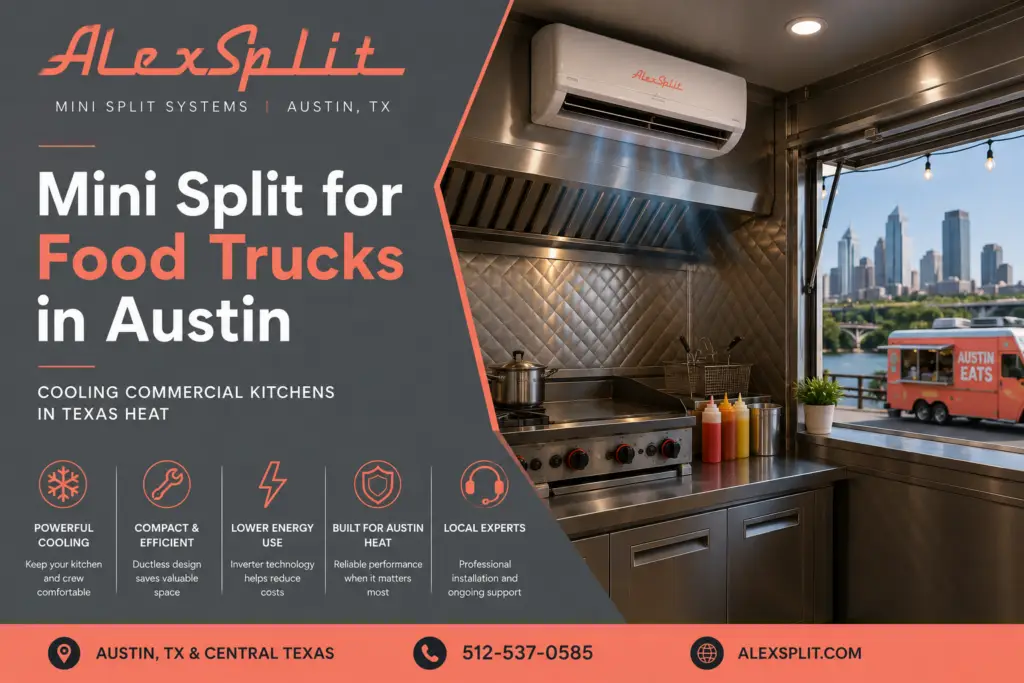
Running a food truck in Austin means operating a commercial kitchen inside a metal box during some of the hottest weather in Texas. Direct sun, hot pavement, fryers, griddles, ovens, refrigeration equipment, generators, lights, employees, and customers opening the service window all add heat. Even with a powerful exhaust hood, the interior can become uncomfortable because ventilation and air conditioning solve different problems.
For many Austin food truck owners, a properly designed ductless mini split system can be one of the most practical ways to add dedicated cooling without sacrificing limited interior space. AlexSplit LLC installs mini split systems for specialized spaces throughout Austin and Central Texas, including food trucks and other compact applications.
Why Food Trucks Get So Hot in Austin
A food truck is very different from a bedroom, office, garage, or ordinary retail space. The cooling system is not simply fighting outdoor temperature. It is fighting several heat sources at once.
The exterior shell absorbs solar heat. A truck or trailer parked in full Texas sun can gain heat through its roof and walls. Commercial cooking equipment continuously releases heat into a very small volume of air. Refrigeration equipment and electrical components can add more heat. Service windows and doors also open repeatedly, allowing warm outdoor air to enter.
A commercial kitchen hood is essential where required because it removes smoke, grease-laden vapor, combustion products, odors, steam, and heat around cooking equipment. But exhaust ventilation is not mechanical cooling. When the hood pulls air out, replacement air has to come from somewhere, and in a food truck much of it may be hot outdoor air.
That is why a truck can still feel brutally hot even when its exhaust fan is working correctly.
Why a Mini Split Works Well for a Food Truck
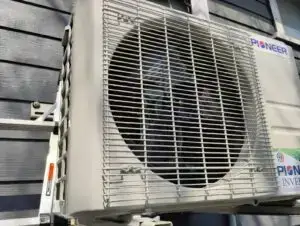
A ductless mini split uses an indoor air-handling unit and a separate outdoor condenser connected by refrigerant lines, wiring, and a condensate drain. Because it does not require large supply and return ducts, it can be easier to fit into a mobile kitchen than a conventional ducted HVAC system.
Space matters in a food truck. Every cabinet, shelf, appliance, prep surface, and walkway has a purpose. A ductless system minimizes the amount of interior space devoted to cooling infrastructure while providing conditioned air where employees need it.
Many modern mini splits also use inverter-driven compressors that can adjust output as cooling demand changes. This can help maintain steadier conditions as the truck moves between prep time, lunch rush, slower periods, and closing.
For an Austin operator, the main advantage is targeted cooling. You are not trying to air condition an entire restaurant. You are trying to control a compact workspace with an unusually high heat load.
The Biggest Mistake: Sizing a Food Truck Mini Split by Square Footage Alone
A 150-square-foot food truck is not the same cooling problem as a 150-square-foot bedroom.
Basic mini split sizing charts often use square footage as a starting point. Carrier’s mini split sizing guidance explains that square footage can provide a preliminary BTU estimate, but insulation, climate, ceiling height, layout, and other conditions affect proper sizing. A professional load assessment is the better approach.
For a food truck, internal heat load can be more important than floor area. The installer should consider the type and quantity of cooking appliances, hood exhaust, replacement air, insulation, service-window size, exterior exposure, number of employees, refrigeration equipment, electrical equipment, operating hours, and Austin summer conditions.
That is why choosing a mini split because “this BTU size covers this many square feet” can disappoint. The unit may cool an empty truck and still fall behind when the grill, fryer, hood, refrigerator, lights, and crew are all working.
Can a Mini Split Keep a Food Truck Cool in Austin Summer?
It can, but system design matters.
A mobile kitchen may have heavy exhaust, constant door openings, high-temperature cooking equipment, and strong solar exposure. The goal should be to determine the actual heat load and select equipment that can provide meaningful cooling under real operating conditions.
Insulation can make a major difference. A poorly insulated trailer continually absorbs heat through its roof and walls. Improving insulation during a buildout can reduce the cooling load before the mini split is even turned on.
Shading can help too. A food truck parked under direct sun on asphalt has a different cooling challenge from the same truck operating under a canopy. Equipment location, condenser airflow, and outdoor-unit exposure also affect performance.
Where Should the Indoor Mini Split Unit Go?
Indoor-unit placement is one of the most important design decisions in a food truck installation.
The air handler should move conditioned air through the occupied workspace without interfering with cooking operations. It should not be placed where grease, steam, or heavy cooking contaminants are likely to be pulled directly into the coil and filter.
The unit also needs clearance for airflow, filter access, cleaning, and service. The installer should consider how employees move inside the truck, where hot equipment sits, how cabinets open, and how the service window affects airflow.
Condensate drainage also needs a reliable route. Air conditioners remove moisture from indoor air, and that water must drain correctly even in a compact mobile layout.
Where Does the Outdoor Mini Split Condenser Go on a Food Truck?
The outdoor condenser needs enough airflow to reject heat effectively. It should not be boxed into a tight compartment or placed where hot kitchen exhaust continually blows across the coil.
Mounting should also account for vibration, road movement, physical protection, service access, weight, and manufacturer-required clearances.
Because a food truck moves, an installation suitable for a stationary building may not automatically be suitable for a trailer or truck. Brackets, fasteners, line-set routing, penetrations, and electrical connections need to be planned around movement.
The condenser should be protected from obvious impact risks without blocking the airflow it needs to operate efficiently.
Generator and Electrical Capacity Matter
Cooling capacity is only part of the design. The food truck must be able to power the mini split along with everything else operating on board.
Cooking appliances, refrigeration, exhaust fans, lights, water heaters, pumps, point-of-sale equipment, and other electrical loads may already consume much of the available electrical capacity.
Before adding HVAC, the electrical system and generator configuration should be reviewed to verify sufficient capacity for the mini split, including manufacturer-specified operating requirements.
A system that is large enough to cool the truck does not help if the available power source cannot support it reliably. HVAC sizing and electrical capacity should therefore be considered together rather than treated as separate decisions.
A Mini Split Does Not Replace Commercial Kitchen Ventilation
This distinction is critical.
A mini split recirculates and conditions indoor air. It is not a substitute for a required commercial kitchen hood, exhaust fan, makeup-air strategy, combustion-air requirement, fire-suppression system, or other code-required kitchen ventilation equipment.
The cooling system should work with the food truck’s ventilation system rather than fight it. If an exhaust hood removes a large quantity of air, that airflow affects the cooling load. Installing a larger air conditioner without understanding where replacement air comes from can still produce poor performance.
Food truck owners building or remodeling a unit should coordinate HVAC, electrical, cooking, ventilation, fire-safety, and permitting requirements before equipment locations are locked in.
Texas Food Truck Requirements Changed in 2026
Food truck operators should also be aware of a recent licensing change.
Beginning July 1, 2026, mobile food vendors operating in Texas must hold a state Mobile Food Vending Permit issued by the Texas Department of State Health Services. Austin Public Health notes that administration of the Mobile Food Vending Program is transitioning to DSHS, while fire inspections and related fire-safety requirements remain separate.
That does not determine which mini split you should install. It means HVAC should be treated as one part of the overall food truck build, with equipment positioned so it does not interfere with required cooking, sanitation, egress, electrical, ventilation, or fire-safety systems.
How to Maintain a Mini Split in a Food Truck
A food truck can be a harsher environment for HVAC equipment than a typical home.
Grease, airborne cooking particles, dust, pollen, road debris, and long operating hours can make cleaning especially important. Filters should be checked regularly. Dirty filters restrict airflow and can reduce cooling performance.
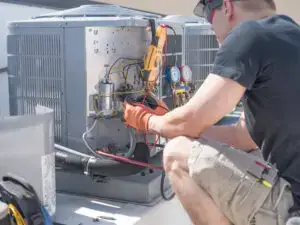
The indoor coil, blower, drain system, refrigerant circuit, electrical connections, and outdoor condenser should also be inspected periodically. The outdoor unit deserves special attention if the truck operates near dusty lots, gravel, or landscaping debris.
Professional HVAC preventative maintenance is particularly valuable when air conditioning is part of daily business operations. A residential AC failure is inconvenient. A food truck cooling failure during a busy Austin lunch service can affect employee comfort and disrupt operations.
What Food Truck Owners Should Ask Before Mini Split Installation
Before choosing equipment, answer several practical questions.
- What cooking equipment normally runs at the same time?
- How much air does the kitchen hood exhaust?
- How well are the roof and walls insulated?
- Is the truck normally parked in full afternoon sun?
- How many people normally work inside?
- What electrical service or generator capacity is available?
- Where can the indoor unit be mounted away from heavy grease?
- Where can the outdoor condenser receive unrestricted airflow?
- How will condensate water drain?
- Will the food truck travel frequently or remain mostly stationary?
Those answers are more useful than square footage alone. A good installation starts with the truck as a complete operating system, not simply an empty box that needs air conditioning.
Why Austin Food Truck Owners Choose AlexSplit
AlexSplit LLC specializes in ductless mini split systems and customized HVAC installations for spaces that do not fit the normal residential mold. AlexSplit works with food trucks, RVs, vans, garages, tiny homes, warehouses, commercial spaces, and other specialized applications throughout Austin and Central Texas.
Food truck HVAC requires more than mounting an indoor head and connecting an outdoor condenser. Equipment capacity, airflow, electrical demand, mounting, drainage, service access, cooking heat, ventilation, and the operating environment all have to work together.
If you are building a new food truck, upgrading an existing trailer, or trying to make an Austin mobile kitchen more comfortable during summer service, AlexSplit can evaluate the space and recommend a mini split configuration based on how the truck is actually used.
Keep Your Austin Food Truck Cooler
Austin food trucks do not stop operating when summer temperatures climb. Your cooling system should be designed for the same reality.
A correctly selected and professionally installed mini split can provide dedicated cooling without filling the truck with bulky ductwork. But food trucks are high-load commercial kitchens, so successful installation depends on proper sizing, equipment placement, adequate electrical capacity, good insulation, maintenance, and coordination with required kitchen ventilation.
For professional food truck mini split installation in Austin, contact AlexSplit LLC or call 512-537-0585 to discuss your food truck, trailer, equipment layout, electrical setup, and cooling needs.